Introduction
Whole Building Life Cycle Assessment (LCA) evaluates the environmental impacts of a building throughout its lifespan, from the extraction of raw materials for its construction to its eventual demolition and waste disposal. This has a significant impact on both the environment and long-term costs. Would you like to know more about how this methodology can drive sustainability and reduce the costs of your project? In this article, we will explain it to you!
1. Life cycle
The life cycle of a product or building refers to the set of stages it goes through from its conception, design, manufacture or construction, use, maintenance, renovation, to the end of its useful life and final disposal.
The life cycle of a product or building can vary depending on its duration and complexity, meaning it relies on various factors, such as the type of material used, the technology involved, and the conditions of use and maintenance, among others. Effective management of this cycle is crucial to optimising efficiency, reducing environmental impact and promoting long-term sustainability.
2. What is Life Cycle Assessment LCA?
The Life Cycle Assessment stroke a methodology, based on regulations, which allows the identification of the environmental impacts of the life cycle of a product, material or building. In the case of LCA in buildings, it allows the evaluation of the environmental impacts generated by the building and its embodied carbon.
The embodied carbon, commonly known as the carbon footprint, is that generated during the manufacture of a material and throughout its life cycle. Calculating embodied carbon is essential for understanding the total environmental impact of a product or project. By knowing the amount of emissions associated throughout its life cycle, informed decisions can be made to reduce these emissions and reduce the contribution to climate change.
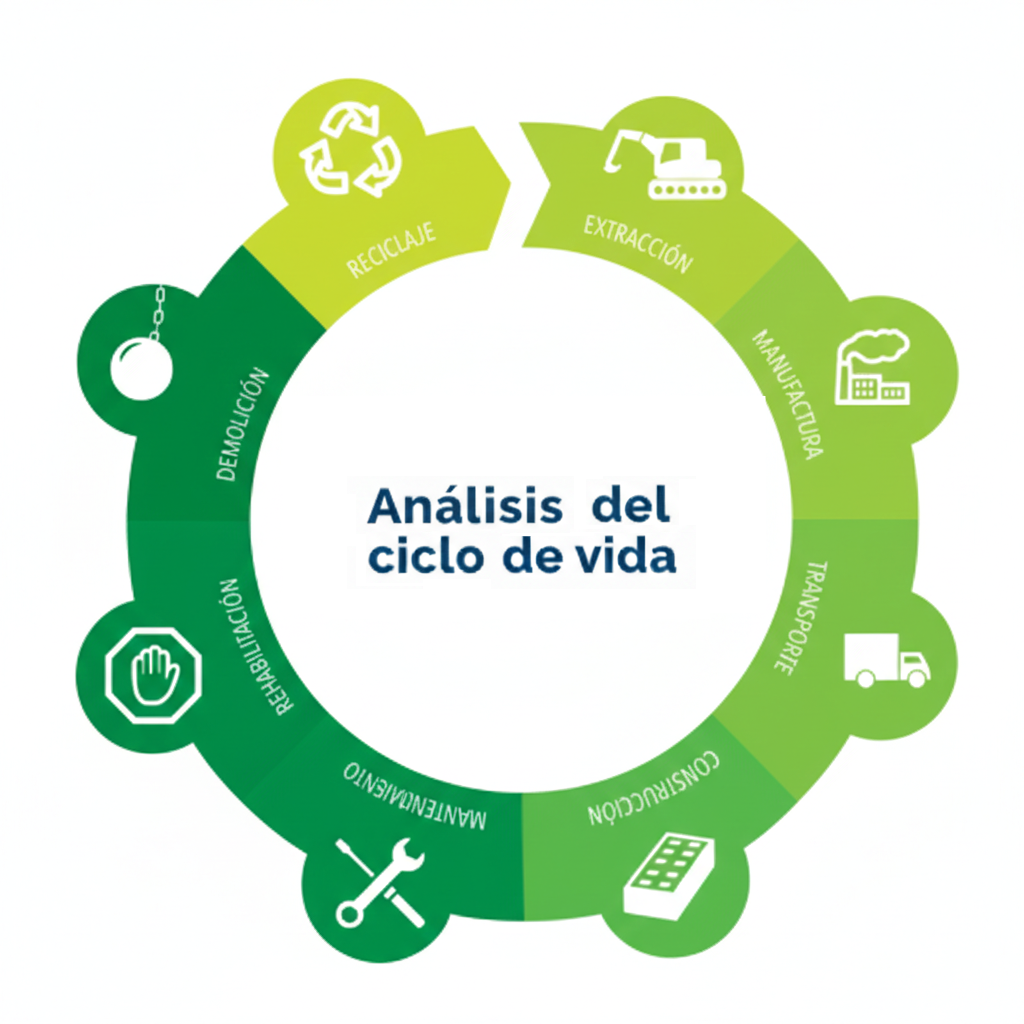
Life Cycle Assessment (LCA). Source: Evalore (own elaboration))
Would you like to carry out a Life Cycle Assessment (LCA) on your building to boost its sustainability?
3. Life Cycle Stages according to EN standard
The life cycle stages of a construction product and of a building, in accordance with the EN standard applicable for the European Union, are defined in the standards: EN 15804 and EN 15978.
Within the Whole Life Carbon assessment of buildings, we categorise emissions into full life-cycle stages, denoted by letters from “A” to “D”, spanning from raw material extraction to the end-of-life disposal of the building. These stages are divided into:
- Product stage (A1-A3): involves the phases of material extraction, transport to product manufacturing, referred to as “emissions”from the cradle to the grave”.
- Construction stage (A4-A5): it covers the transport of the construction product from the manufacturer (factory gate) to the construction site, the installation of the product in the building, and installation waste, and includes the necessary labour and equipment.
- Usage stage (B1-B5)during this phase, the construction product is used in the building or project, and its operations and performance are evaluated throughout its service life. It covers all maintenance and refurbishment activities that may be carried out during the life cycle of the building or project.
- Operational stages (B6-B7): it encompasses energy consumption (B6) and water consumption (B7). In some projects, this stage is excluded depending on the objective of the analysis. The project scope may not include the detailed analysis of the operational stages, especially if the main objective of the LCA is to assess the environmental impact of the building's construction and demolition stages.
- End-of-life stage (C1-C4): it covers the impacts associated with the demolition, transport, treatment and final disposal of the building's materials once its useful life has ended.
- Benefits stage (D): consider the impacts avoided thanks to the reuse, recycling or recovery of materials at the end of their useful life, accounting for the environmental benefits beyond the building system.
Cradle-to-grave emissions are stages A, B and C combined; the entire life cycle, including stage D, is known as cradle-to-cradle emissions.
By following these stages, the environmental and economic impact of a construction product or building can be calculated from extraction to disposal, which enables informed decisions to be made in the choice of more sustainable materials and construction methods.
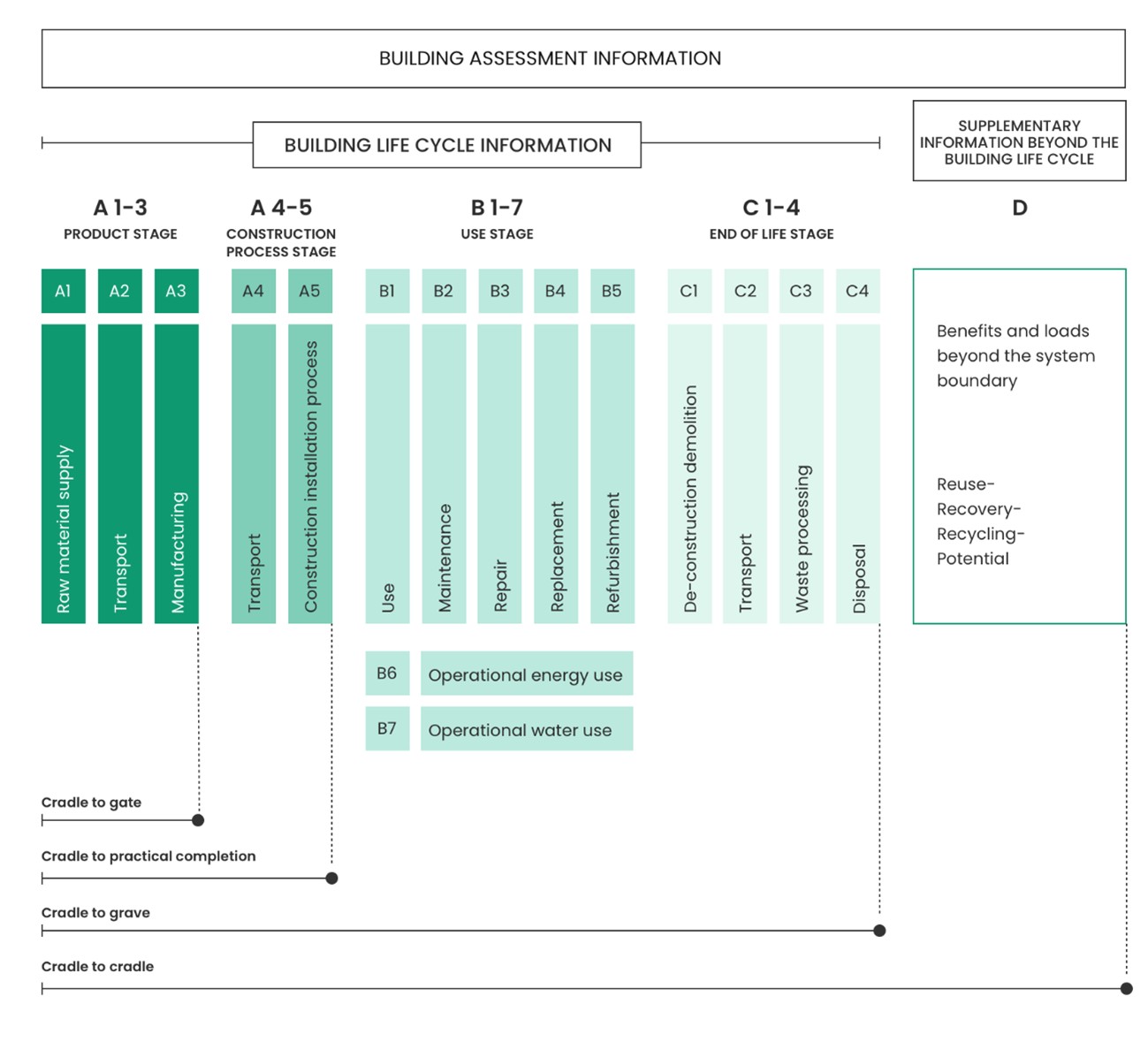
Source: One Click. Image edited by Evaluate
4. Stages of a stroke
Building life cycle assessment consists of several interrelated phases that evaluate the environmental impact of all stages of a building's life cycle, from raw material extraction to construction, use, maintenance and eventual demolition or recycling. These phases generally include:
- Aim and scope: consists of defining the specific objectives and the stages of the life cycle considered.
- Inventory analysisIn this phase, data on the building must be gathered, such as its design, construction materials and measurements, energy consumption, water use and waste management.
- Environmental impact assessmentIt is based on the analysis of the preliminary results.
- Interpretation: it is the final phase, where opportunities for improvement are identified.
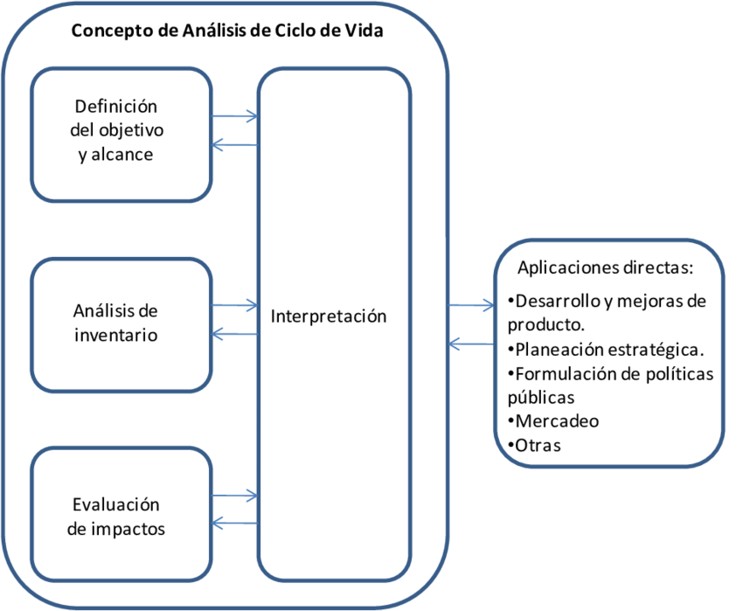
LCA stages. Source: ISO 14040.
The phases of an LCA are carried out iteratively and may vary in detail depending on the specific context of the life cycle assessment and the project objectives. The ultimate goal of a building's LCA is to identify opportunities to reduce environmental impact throughout its life cycle and promote the construction of more sustainable and environmentally friendly buildings.
5. Environmental impact categories evaluated by the LCA
The environmental impact categories assessed by Life Cycle Assessment (LCA) are specific aspects of the environment that can be affected by a product, process or service throughout its life cycle. LCA uses indicators and models to quantify and compare these impacts, which provides a comprehensive understanding of the environmental effects associated with a specific activity and enables informed decisions to be made to improve sustainability. Some of these are as follows:
- Global warming potential (greenhouse gases), kg CO2e: describes how much a product contributes to climate change.
- Acidification of terrestrial and water sources (kg SO2): describes how much a product acidifies the environment (acid rain).
- Eutrophication (kg N or kg PO4e): describes the excessive flow of nutrients between ecosystems (algal growth).
- Ozone depletion (kg CFC-11): describes the damage caused to the ozone layer in the stratosphere.
- Tropospheric ozone (kg NOx, kg O3 eq or kg ethene): describes the amount of smog caused by the emitted gases.
- Depletion of non-renewable energy resources (expressed in megajoules MJ): it measures the amount of non-renewable energy consumed during all stages of the life cycle of a product, process or service, including fossil fuels such as oil, natural gas and coal.
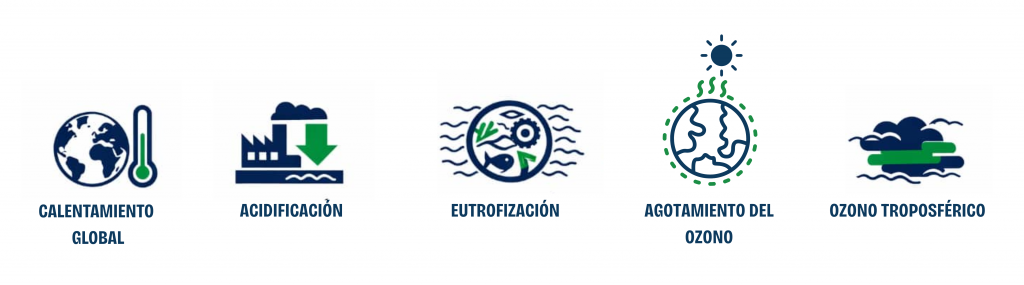
Environmental impact categories in LCA. Source: Evalore
In buildings, most of the environmental impacts come from the product stage (A1-A3), that is to say, of the embodied carbon of the construction materials. The amount of these impacts is declared in a standardised document called Environmental Product Declaration (EPD), this includes the results of a product life cycle assessment.
6. Tools and Methods
Life cycle analysis is carried out through various tools and methods, including Life Cycle Assessment (LCA) and Life Cycle Costing (LCC). The former focuses on environmental impact, while the latter analyses the economic costs of the project.
At Evalore we recommend the use of specific Life Cycle Assessment (LCA) software, as it allows for precise comparisons between different designs or materials, automates calculations and yields results consistent with the main standards (EN 15804 and EN 15978). These tools also facilitate integration with BIM models and the generation of reports compatible with green building certifications such as LEED and BREEAM, as well as the Level(s) assessment framework. However, the analysis can be carried out manually using environmental impact factors per material type obtained from recognised databases or verified EPDs, thereby ensuring the traceability and consistency of the results.
It is important to highlight that the choice of LCA software should be based on the specific needs of the project, compatibility, and the requirements of sustainability certifications. One of the specialised LCA platforms is One Click LCA, provides a comprehensive overview of the environmental impact of projects, offering access to an extensive life cycle inventory database that includes information on building materials, energy, transport, maintenance and end-of-life. Furthermore, it provides calculation tools for the LCA of internationally recognised environmental certifications such as LEED y BREEAM, and for the Level(s) evaluation framework, helping to meet the requirements of sustainable building certifications and standards.
The following graph reflects the results, in numerical values (kg), of a life cycle assessment (LCA) of a building project with an area of 2,929.45 m2. According to the materials used in the construction, the environmental impacts are quantified.
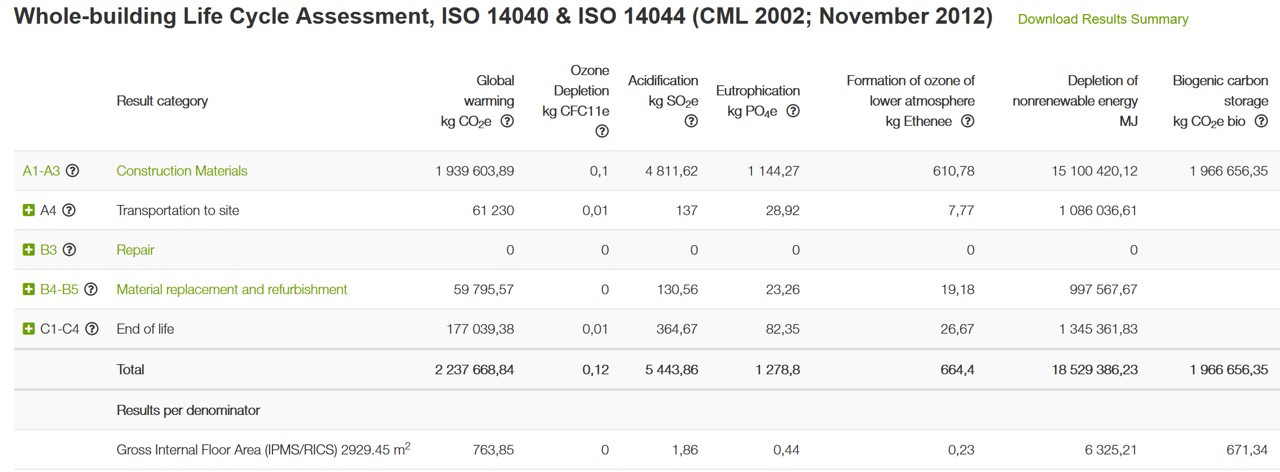
Source: One Click. Image edited by Evalore
Using the One Click tool, charts showing percentages of embodied carbon in materials can be viewed and downloaded according to their classification and the life-cycle stage to which they belong, for example: foundations, structures and façades, beams, slabs and roofs.
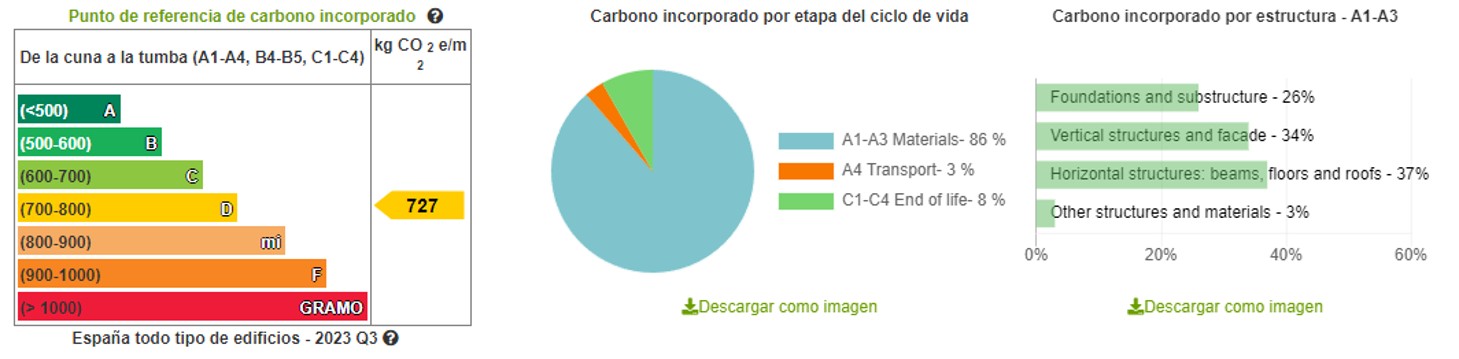
Source: One Click. Image edited by Evalore
7. Sustainability certifications and LCA
The main building sustainability certifications such as LEED and BREEAM, among others, include LCA as a tool in their assessment requirements. Likewise, the Level(s) evaluation framework incorporates life cycle analysis as one of its main tools for assessing the environmental impact of buildings. However, the scope of the life cycle and the types of environmental impacts to be analysed vary between the certifications and the evaluation framework.
According to LEED v4 specifications, the following elements are excluded from the analysis: electrical and mechanical equipment and controls, plumbing fixtures, fire alarm and detection system accessories, lifts and transport systems, excavations and other site developments, and car parks. Adding them will not provide any additional credit.
Whereas for BREEAM, the scope of the LCA must obligatorily include the following elements: facades, exterior windows and rooflights, interior flooring, upper floor slabs, ground floor slab, vertical interior partitions and party walls, and roofs. Unlike LEED, the more building elements that are included in the assessment, the greater the percentage of points achieved.
In the case of Level(s), the minimum scope of building elements must include: foundations, structural load-bearing frame, slab, interior walls, partition walls, stairs, façades, roof and parking.
If we analyse the environmental impact categories that these two certifications evaluate—LEED and BREEAM—we observe that the Level(s) framework covers more categories in comparison with the LEED and BREEAM certifications, including the abiotic depletion potential of both fossil and non-fossil resources.
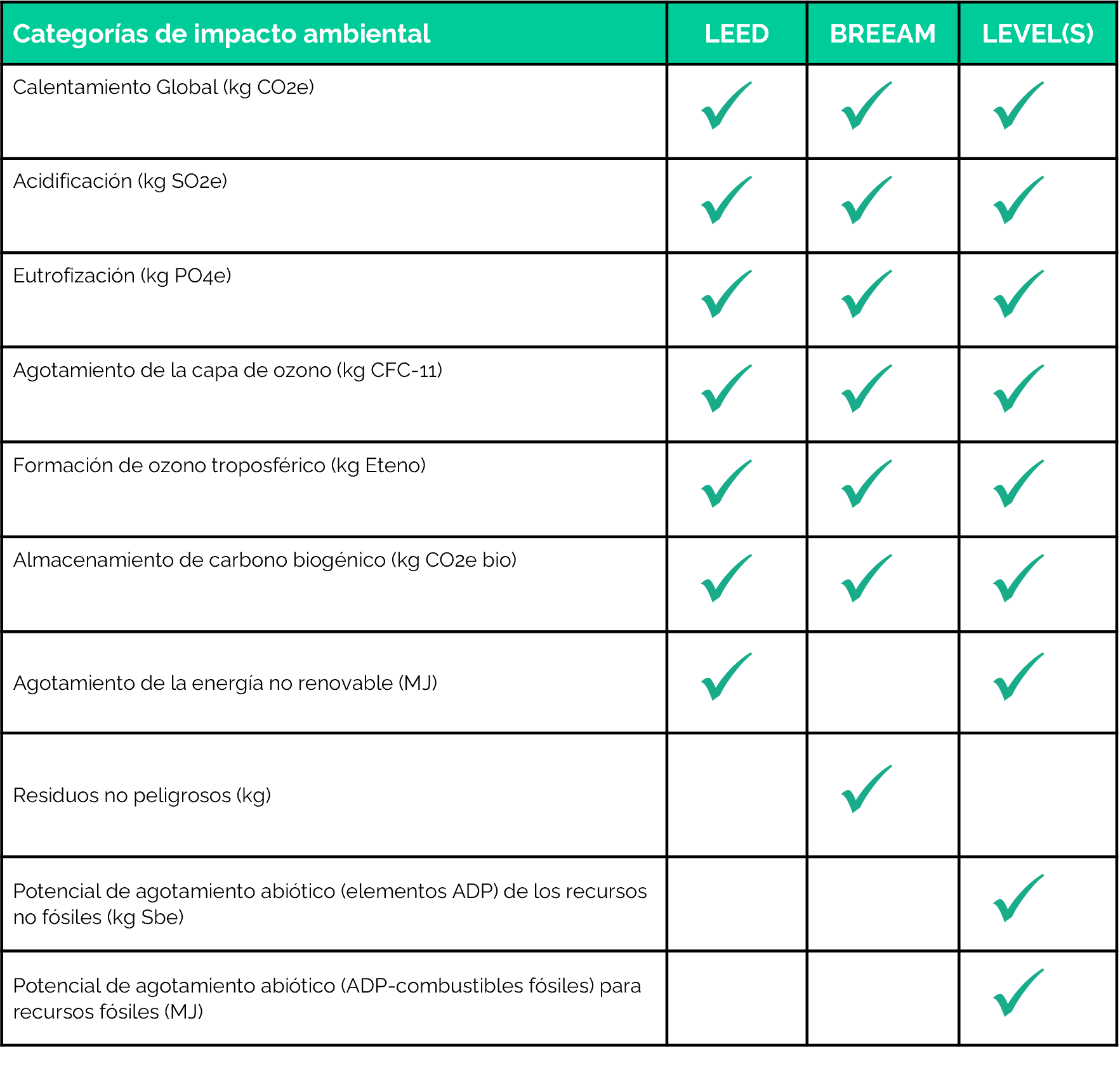
Analysed environmental impact categories. Source: Evalore
8. Life Cycle Assessment Advantages
The LCA provides the necessary basis for making informed material selection decisions, contributing significantly to the reduction of environmental impacts such as greenhouse gas emissions, resource consumption and waste generation. It also analyses economic aspects, including operating costs, maintenance, renewal and demolition, through Life Cycle Costing (LCC).
Extension of the building's lifespan, by using adaptable and durable materials, as well as considering maintenance.
Optimisation of project design and reduction of resource consumption, LCA makes it possible to identify the life cycle stages that have the greatest environmental impact and to provide solutions to reduce them; to make comparisons between designs, for example, by using optimal thermal insulation for the building, energy consumption is reduced; or comparisons between structural systems, which make it possible to reduce the volume of materials.
Would you like to carry out a Life Cycle Assessment (LCA) on your building to boost its sustainability?
By assessing the environmental impact of a project from its conception to its demolition, LCA allows us to make informed decisions that minimise our impact on the environment and promote a more sustainable future.
Implementing LCA not only benefits the environment, but can also lead to greater energy efficiency, long-term cost savings, and improved occupant wellbeing.
Discover how this Building Life Cycle Assessment methodology can take your construction projects to the next level in sustainability and efficiency. Contact us to find out more!

Laura Barrios Mogollón
Architect and Sustainability Consultant, EsPacios Evalore SLP